A working horse needs consistent, controlled exercise — and the method you choose shapes your daily barn labor, your footing wear, and your capital budget for years. A eurowalker can exercise four to six horses at once on engineered footing. Traditional methods — hand-walking, hot-walking, lunging, round-pen work, and conditioning tracks — rely on handler time and different surface builds. This guide compares the two, walks through what each construction actually looks like on the ground, and gives property owners the numbers needed to make a grounded decision.
What a Eurowalker Actually Is
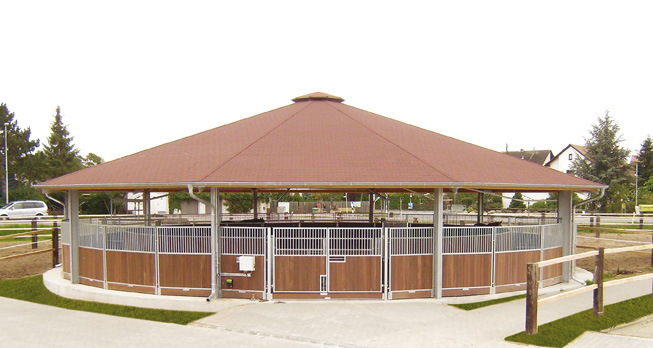
A eurowalker is a covered, mechanized horse exerciser built as a large circular or oval structure with divided sections — typically four, five, or six — that rotate at a set speed, moving horses around a central hub. Unlike older "hot walkers" that tethered horses to rotating arms, a eurowalker uses physical partitions, so horses move freely without a lead rope and without contact with each other.
Commercial eurowalker systems from documented European manufacturers commonly offer diameters ranging from about 12 meters (roughly 40 feet) for four-horse units up to 21 meters (nearly 70 feet) for six- or eight-horse commercial units. Speed is adjustable — typical ranges are walk, trot, and slow canter — and programs can be preset for warm-up, conditioning, and cool-down sequences.
The appeal for a working equestrian property is straightforward: one staff member can supervise a full rotation of horses instead of walking each animal individually, and footing wear is spread evenly across a controlled circular track instead of concentrated in a handler's favorite lunging spot.
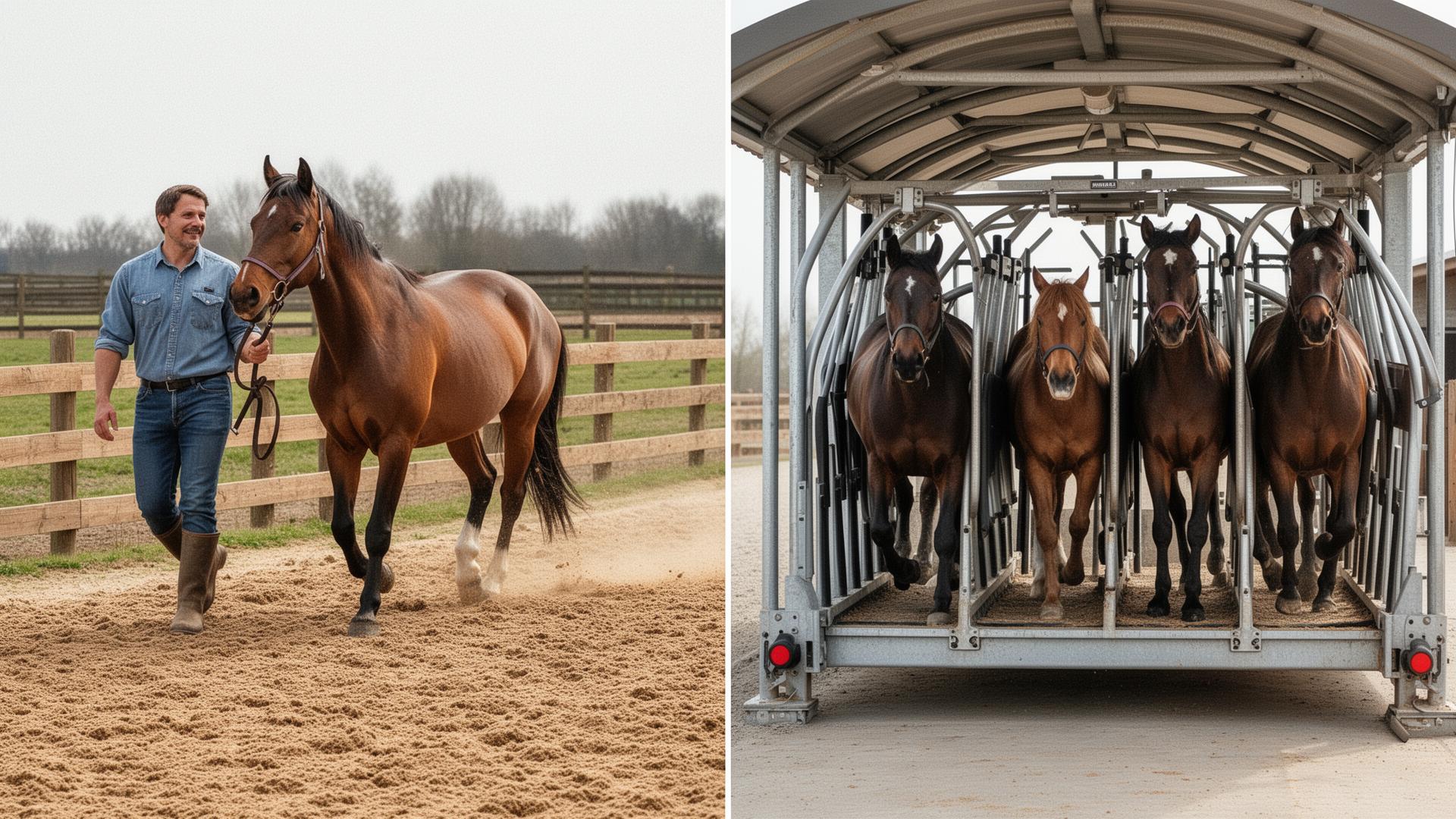
What "Traditional" Horse Exercise Covers
"Traditional" isn't one thing. It's a category that includes:
- Hand-walking — a handler leads one horse at a time on a lead rope, usually along a barn aisle, a gravel drive, or a dedicated walking track.
- Hot-walking machines — older mechanical units that tether horses to rotating overhead arms, still used on many training operations.
- Lunging — working a horse in a circle on a long line inside a round pen or small arena.
- Round-pen work — free or long-line exercise inside a purpose-built circular enclosure, typically 50 to 60 feet in diameter.
- Conditioning tracks — straight or oval sand or stonedust tracks used for measured trot and gallop work.
Each method has a place. The question for property owners is which combination of these — and whether a eurowalker complements or replaces them — makes sense for their operation, their herd size, and their site.
How Groundshapers Approaches a Eurowalker Construction
A eurowalker isn't a machine you bolt down on existing ground. The pad underneath is the actual engineering project, and that's where Groundshapers focuses with our equestrian site construction services.
Step 1 — Site Selection and Drainage Assessment
We walk the site, evaluate soil drainage, and locate the eurowalker away from seasonal water flow paths. A covered eurowalker is used year-round, so the pad must drain under the canopy even when surrounding pasture is saturated. We run a percolation test to confirm infiltration rate and identify whether supplemental drain tile is needed — see our arena and paddock drainage solutions for the full approach.
Step 2 — Excavation and Grading
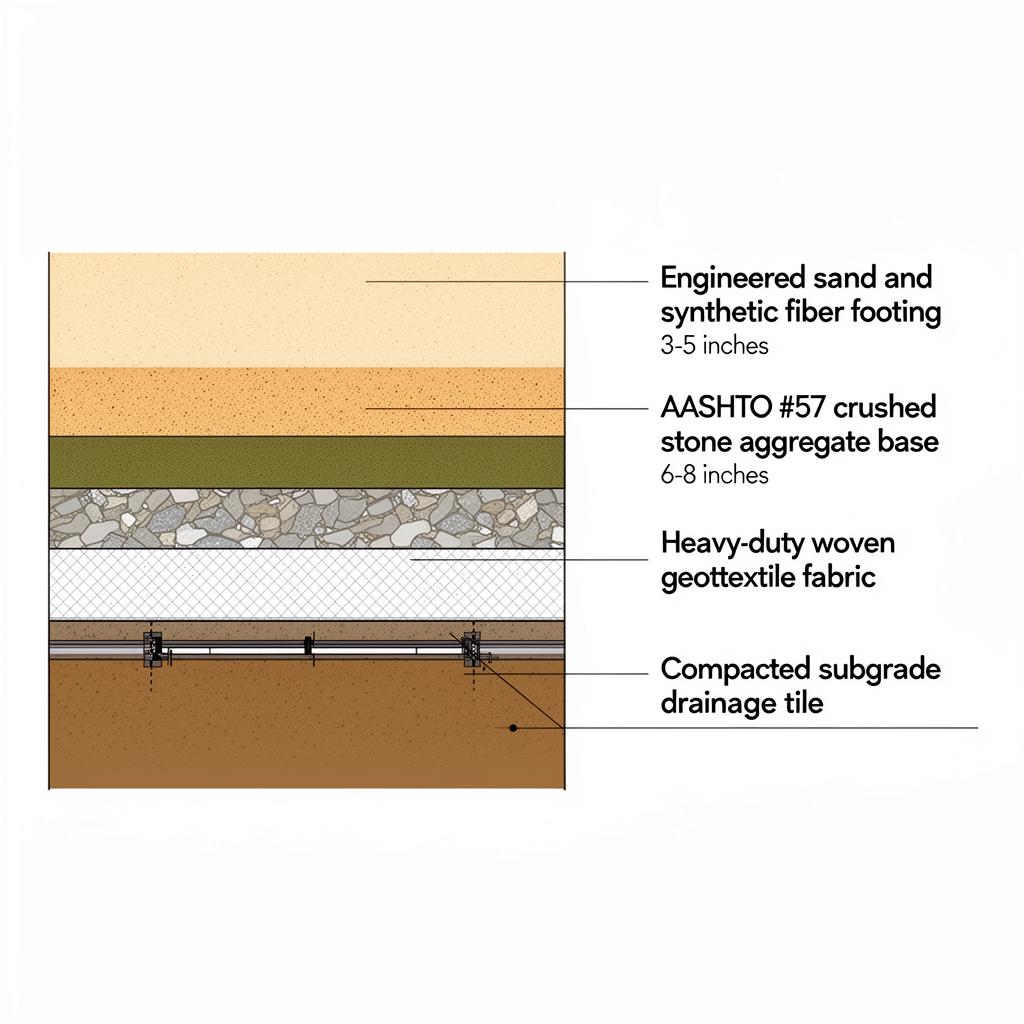
We excavate the circular footprint — typically 14 to 22 meters in diameter depending on the model — plus a perimeter work margin. Excavation depth usually runs 10 to 14 inches below finished footing grade to allow for a full base profile. The subgrade is shaped with a slight outward crown or consistent slope so water moves off the track instead of pooling at the center.
Step 3 — Subgrade Stabilization and Geotextile
The compacted subgrade is covered with a heavy-duty woven geotextile fabric. This is the layer most often skipped on cheaper installs, and it's the reason those installs develop soft spots within two to three seasons. The fabric keeps subgrade soil from migrating up into the clean aggregate.
Step 4 — Aggregate Base
We install a graded stone base — typically 6 to 8 inches of AASHTO No. 57 crushed stone — compacted in lifts. On sites with heavy clay, we add a lower layer of larger stone to create a secondary water reservoir. This is the load-bearing layer that carries horse traffic for the life of the facility.
Step 5 — Footing Installation
The top layer is the footing the horses actually travel on — typically a blend of washed silica sand with synthetic fiber or fleece additives engineered for equine use. Depth runs 3 to 5 inches depending on the manufacturer's footing specification. Groundshapers installs footing to the eurowalker manufacturer's warranty requirements, because incorrect depth or material voids most machine warranties.
Step 6 — Canopy and Equipment Foundation
The eurowalker's central hub and canopy supports sit on engineered concrete footings poured to the manufacturer's load spec, typically frost-depth in northern climates. The machine itself is installed by the manufacturer's certified team; Groundshapers delivers a level, drained, correctly loaded pad ready for that install.
Timeline You Can Plan Around
A typical Groundshapers eurowalker pad build — excavation through footing installation — is a 3 to 5 week project depending on weather, site conditions, and canopy requirements. The manufacturer's equipment install usually follows in an additional 1 to 2 weeks.
How Groundshapers Builds Traditional Exercise Infrastructure
Traditional methods need built surfaces too, just different ones.
Conditioning Tracks
A proper conditioning track is a graded oval or straight run, typically 10 to 15 feet wide, with a crowned subgrade, geotextile, aggregate base, and a stonedust or sand-fiber top. Groundshapers typically builds 400-meter to quarter-mile ovals where property allows. Drainage is the hardest part — a track that ponds at the low end will turn into a boggy trench within one winter.
Round Pens
A 50- to 60-foot round pen is a much smaller construction project but still needs the full base profile: subgrade, geotextile, 4 to 6 inches of compacted aggregate, and 3 to 4 inches of engineered footing. Without the base, heavy use creates a "donut rut" along the rail within weeks.
Hand-Walking Surfaces
Many owners underinvest here and regret it. A hand-walking loop around a barn or paddock should be a stable, all-weather surface — typically a crushed-stone path or a compacted stonedust walkway with proper drainage slope. Groundshapers treats this as a hardscape build, not an afterthought, because it's the one surface that gets daily use 365 days a year.
Measurable Outcomes: What Each Method Actually Delivers
Comparing the two honestly requires looking at labor, throughput, and site investment together.
Labor Per Exercise Session
- Hand-walking: one handler per horse. A 30-minute walk for six horses equals three handler-hours plus turnaround time.
- Hot-walker (traditional): one handler can tie up two to four horses; requires constant supervision because tethers can tangle.
- Lunging / round pen: one handler per horse, 20 to 30 minutes of active work.
- Eurowalker: one handler loads and unloads up to six horses per session and supervises from outside the structure. A 30-minute session exercises six horses in roughly the same time it takes to hand-walk one.
Footing Wear and Surface Life
A properly built eurowalker track distributes wear evenly around the circle, so footing tops up on a predictable schedule — typically every 12 to 18 months for a working facility. Round pens and hand-walking trails, by contrast, develop concentrated wear patterns that require spot top-ups several times per year.
Weather Tolerance
A covered eurowalker operates in rain, snow, and heat. An outdoor conditioning track, round pen, or hand-walking trail is weather-dependent unless covered. For properties in climates with significant freeze-thaw or heavy rainfall, the eurowalker's year-round availability is often the deciding factor.
Capital Investment
This is the honest trade-off. A commercial eurowalker with canopy and engineered pad represents a significant capital investment — typically in the six-figure range for a four- to six-horse system installed. A round pen build or a conditioning track build is a fraction of that cost. The eurowalker pays back on labor and consistency; the traditional methods pay back on low capital and flexibility.
Herd Consistency
A eurowalker delivers the same speed, duration, and surface every session. For conditioning programs — rehab, legging-up, or pre-competition work — that consistency is the actual product. Traditional methods depend on handler skill and daily judgment.
Who Each Method Actually Suits Best
Four scenarios show up repeatedly in equestrian site consultations.
- Private owner, 2 to 4 horses: a well-built round pen plus a conditioning hand-walking loop usually delivers more value than a eurowalker. The capital is lower and the herd size doesn't justify the machine.
- Small training or boarding barn, 8 to 15 horses: this is the tipping point. A four-horse eurowalker often pays back on labor savings within three to five years, especially if the operation runs structured conditioning programs.
- Commercial training, rehab, or breeding operation, 20+ horses: a six-horse eurowalker is usually core infrastructure, paired with conditioning tracks and round pens for specific work.
- Agritourism and lesson barns: a eurowalker can be a visible asset that also cuts labor — covered exercise for school horses during bad weather keeps lessons running and horses conditioned.
Practical Implementation Guide for Your Property
Whether you're leaning toward a eurowalker, upgrading traditional infrastructure, or both, the construction sequence is similar at the fundamentals.
Step 1 — Start with Drainage
Every equestrian surface fails at the drainage step first. Percolation test, drainage plan, and water-routing are not optional. Groundshapers runs these as a standard part of any site assessment.
Step 2 — Match the Surface to the Use
A eurowalker pad, a conditioning track, a round pen, and a hand-walking loop all use different footing depths and materials. Do not reuse one spec for another.
Step 3 — Build the Base Correctly
Skipping the geotextile or under-sizing the aggregate base is the single most common reason equestrian surfaces fail within two to three years. The work you can't see is the work that matters.
Step 4 — Install Footing to Manufacturer Specification
For a eurowalker, the machine manufacturer will specify footing type and depth. Install to that spec — it's tied to the equipment warranty.
Step 5 — Plan Maintenance from Day One
Eurowalker footing needs regular grooming (typically daily) and top-up (every 12 to 18 months). Traditional surfaces need harrowing, weed control, and spot repair. Groundshapers includes a maintenance schedule with every build.
Mistakes We Help Clients Avoid
- Placing a eurowalker on a low-drainage site without supplemental tile
- Under-sizing the aggregate base for horse traffic loads
- Skipping geotextile on any equestrian surface
- Choosing footing by price instead of by manufacturer specification
- Building a conditioning track without a crowned subgrade
Conclusion
A eurowalker and traditional horse exercise methods solve overlapping but different problems. The eurowalker delivers consistency, labor efficiency, and year-round use — and demands a serious capital investment and a correctly engineered pad underneath. Traditional methods deliver flexibility and lower capital cost, and depend more heavily on handler time and weather. Both succeed or fail based on what gets built below the surface: drainage, subgrade, geotextile, and aggregate.
Your next step: schedule a Groundshapers site assessment. We'll evaluate your drainage, measure your available footprint, and give you a specific construction quote for whichever path fits your operation — eurowalker pad, round pen, conditioning track, or a combined build. That one visit turns a capital decision you've been circling into a project you can plan around.
This article references publicly available information from eurowalker manufacturer technical specifications, University of Kentucky Equine Science extension resources, the American Association of Equine Practitioners, and published equestrian facility construction guidance. All dimensions, timelines, and construction specifications are drawn from documented industry sources and Groundshapers project experience. Results and costs described may vary based on site conditions, climate, herd size, and equipment selection.
Frequently Asked Questions
Ready to Start Your Project?
Get a free consultation and custom quote from our expert equestrian ground team.
Request a Free Quote